



As a sales leader, you are likely feeling immense pressure to do something with AI. Your board is asking about it, competitors are announcing new initiatives, and the vendor noise is constant. Yet, for most teams, there is no clear starting point. Many organizations find themselves stuck somewhere between random experimentation and genuine execution, unsure of how to turn the promise of AI into measurable pipeline results.
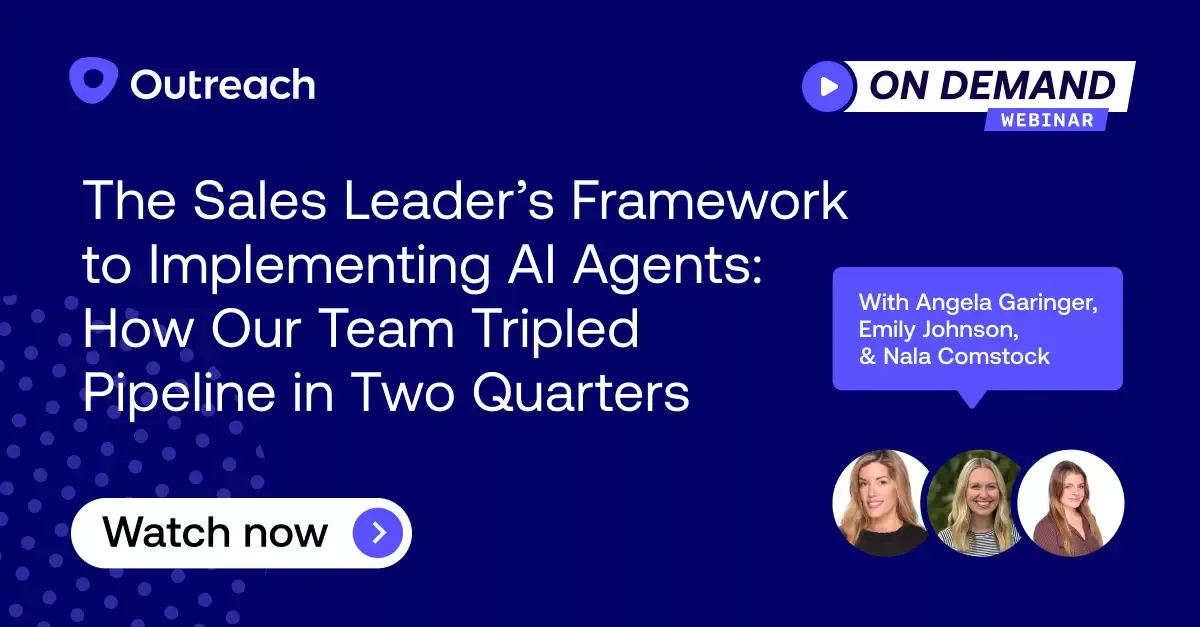
This isn’t just theory for us at Outreach. In a recent webinar, I had the opportunity to discuss with Emily Johnson, our senior product marketing manager, and Nala Comstock, our senior sales operations manager, how we’ve moved beyond the hype to implement a practical framework for deploying AI agents within our sales organization.
The results have been significant:
- Over just two quarters, we achieved three times our normal pipeline growth, jumping from $3.6 million to $10.1 million.
- We also saw a 62% increase in closed-won revenue, all with zero changes to our headcount.
The core principle behind this success is simple. AI agents deliver results when you treat them like teammates. This means giving them defined roles, clear accountability, and consistent measurement. Here is the framework we used to make it happen.
The pressure is real. The starting point isn't.
The pressure to adopt AI in sales is undeniable. But most rollouts stall for highly predictable reasons. There is often no clear owner, the use cases remain undefined, and teams lack a framework for measuring success. This leads to confusion, frustration, and a lack of real progress.
The key insight we discovered was to start where buyer intent, human effort, and execution pressure already exist. We developed three criteria to identify the right first use case for an AI agent.
The three criteria for your first AI agent use case:
- Buyer intent already exists within the workflow.
- Humans are already attempting to execute the work.
- Execution is currently inconsistent or leaking value.
Why inbound follow-up is the right first-use case
Based on these three criteria, inbound follow-up is the ideal starting point. It is a workflow with a high buyer signal, a measurable response rate, and a low risk of brand damage. When an inbound lead arrives, the signal is clear. The problem is that inconsistent or slow human follow-up lets that intent go to waste.
In practice, this is what an automated workflow looks like. While inbound follow-up is an ideal starting point, the impressive outcomes we achieved were the result of combining both inbound and outbound motions. An AI agent detects inbound intent, personalizes the initial outreach, and initiates a sequence, while also supporting outbound efforts to engage prospects proactively. This integrated approach unlocked incredible gains for our team, including a 110% increase in prospects contacted, a 40% increase in responses, a 68% increase in prospects invited to meetings, and an 84% increase in opportunities created.
How our team tripled pipeline in two quarters
The strategies above work best when pipeline data, deal signals, and seller activity live on a single platform. Outreach connects conversation intelligence, deal management, and forecasting into one view so your team can spot stalled deals earlier, compress cycle times, and convert more pipeline to revenue. See what faster velocity looks like for teams like yours.
Define who does what: human vs. agent
To succeed, you must be absolutely clear that AI agents do not replace your sellers. Instead, they absorb the repetitive, time-consuming work that pulls sellers away from high-value activities. We call this the Human + Agent execution model, and it serves as a foundational part of our framework.
Ambiguity in this division of responsibility leads directly to accountability gaps and failed rollouts. You must define what each party owns from day one.
- The Agent Owns: Inbound follow-up sequencing, targeted outbound sequencing, prospect research, CRM updates, and meeting scheduling triggers.
- The Seller Owns: Relationship development, complex negotiation, judgment calls, and deal strategy.
This clarity enables reps to focus their energy on the conversations that actually close deals, while the agent handles the initial legwork — such as inbound follow-up, targeting, and signal-based prospecting for outbound motions — with speed, accuracy, and consistency.
Sales leader sets strategy. RevOps executes.
A successful AI agent deployment requires a strong partnership between sales leadership and Revenue Operations. Each function has a distinct and critical role to play.
The sales leader defines the target workflows, sets the agent’s goals, approves the operational guardrails, and owns the ultimate business outcomes. RevOps translates that strategic vision into technical workflows, configures the agent’s logic, builds the necessary prompts, and ensures data integrity across the system.
This partnership ensures that what "good" looks like in your strategy is perfectly mirrored in the agent's day-to-day execution. It completely prevents agents from operating without clear direction or operational oversight.
This is not an experiment. This is how we sell now.
One of the most critical elements of a successful rollout is the mindset shift required from the top down. AI agents cannot be treated as optional pilots, beta tests, or temporary side projects. They must become a core part of your daily sales motion. I was explicit with my own team, telling them that this is how we sell now.
When leaders frame agents as teammates rather than just software tools, adoption accelerates naturally. Your team needs to understand exactly what the human rep owns versus what the AI agent owns. Consistency in this message builds the trust needed for reps to integrate agents seamlessly into their daily rhythm.
Launch with clear expectations and accountability
A structured rollout is essential for building momentum and establishing trust. We approached our launch in three distinct phases, treating the launch date as the starting line rather than the finish line.
Define:
- Identify the specific workflow to automate.
- Set clear, measurable objectives for the agent.
- Establish operational guardrails for safety and compliance.
- Define success metrics clearly before you launch.
Deploy:
- Run a controlled launch with a defined cohort of reps.
- Conduct focused micro-trainings covering what the agent will do, what the rep is still responsible for, and how performance will be measured.
- Set a clear window for measurement.
Review:
- Evaluate agent performance against your predefined benchmarks.
- Inspect workflow health to ensure actions triggered correctly.
- Identify and analyze any friction points for your human sellers.
- Iterate quickly based on hard data rather than anecdotes.
We made early wins highly visible across the entire sales floor. This transparency was crucial for building the adoption momentum we needed to scale the program successfully.
Measure agents like reps
If you intend to treat agents like teammates, you must also measure them with the exact same rigor. They need to be held to the same performance standards as your human sellers.
We track core sales metrics for our agents every single week. These metrics include open rate, reply rate, meetings booked, pipeline created, and closed-won revenue influenced.
In addition to output metrics, we also conduct regular operational inspections. We monitor workflow health to ensure triggers fire correctly, check task compliance to verify reps are completing their portion of the work, and benchmark sequence performance over time. This weekly inspection cadence allows leaders to review both agent and rep performance together, making iteration a structured process of optimization rather than a reactive troubleshooting exercise.
Feedback is a signal, not a veto
A common failure mode for new AI initiatives occurs when leaders allow initial rep feedback to become a veto. Resistance to change is natural, but it is deeply important to distinguish between a legitimate signal and a simple reaction that halts progress.
When a seller flags an issue with an agent's behavior, we use it as an opportunity to investigate. Is this a data quality problem, a configuration issue, or simply an expectations mismatch? We provide a framework for evaluating this feedback, address the root cause, and iterate. The goal is continuous improvement, not avoidance.
Key takeaways for sales leaders
Implementing AI agents is fundamentally about operational discipline, not just deploying new technology. The teams that build this discipline now are the ones who will pull ahead in pipeline generation and revenue predictability.
Here is the framework summarized in five actionable points:
- Start with high-signal workflows. Inbound follow-up is often sethe right first move.
- Define the Human + Agent model before you launch anything.
- Build the Sales Leader and RevOps partnership deeply into your rollout structure.
- Measure agents with the exact same rigor you apply to human reps.
- Treat rep feedback as a signal to iterate, not a reason to stop.
AI agents work best when they are treated like actual members of the team, complete with clear goals, consistent oversight, and measurable accountability. The business case is clear, and the time to start executing is now.
The sales leader’s framework to implementing AI agents
See how one sales team tripled pipeline in just two quarters while increasing closed-won revenue by 62% with the exact same team size. In this on-demand session, you will learn where to start with AI agents, how to prioritize the right workflows, and how to translate strategy into measurable results, with minimal need for prompt engineering.
Revenue leader framework FAQs
What is the difference between an AI assistant and an AI agent in a sales context?
AI assistants typically provide recommendations and surface insights for humans to act on. AI agents execute tasks autonomously within defined guardrails, completing workflows like follow-up sequencing, research, and CRM updates without requiring human initiation at each step.
What is the best first workflow to automate with AI agents?
Inbound lead follow-up is usually the best place to start. It contains clear buyer intent, has easily defined success metrics, and offers measurable response rates. This allows sales leaders to remove execution lag while maintaining quality control and full visibility into revenue impact.
How do you hold AI agents accountable for results?
You can hold agents accountable by measuring them with the same metrics you apply to sellers. Track open rate, reply rate, pipeline created, and revenue influenced. It is important to set a measurement window before launch and to review performance on a weekly cadence.
What does the Sales Leader vs. RevOps partnership look like in practice?
The sales leader sets the agent’s objectives, approves its guardrails, and owns the business outcomes. RevOps is responsible for configuring the agent, managing data integrity, monitoring performance, and driving iteration. Without both sides aligned, rollouts can easily lose strategic direction or operational support.
Revenue leader framework FAQs
The best approach is to treat resistance as a signal, not a veto. Evaluate whether the feedback points to a data quality issue, a configuration gap, or a broader change management challenge. Iterate to fix the root cause, but do not shut the program down simply because of early friction.

Stay up-to-date with all things Outreach
Get the latest product news, industry insights, and valuable resources in your inbox.